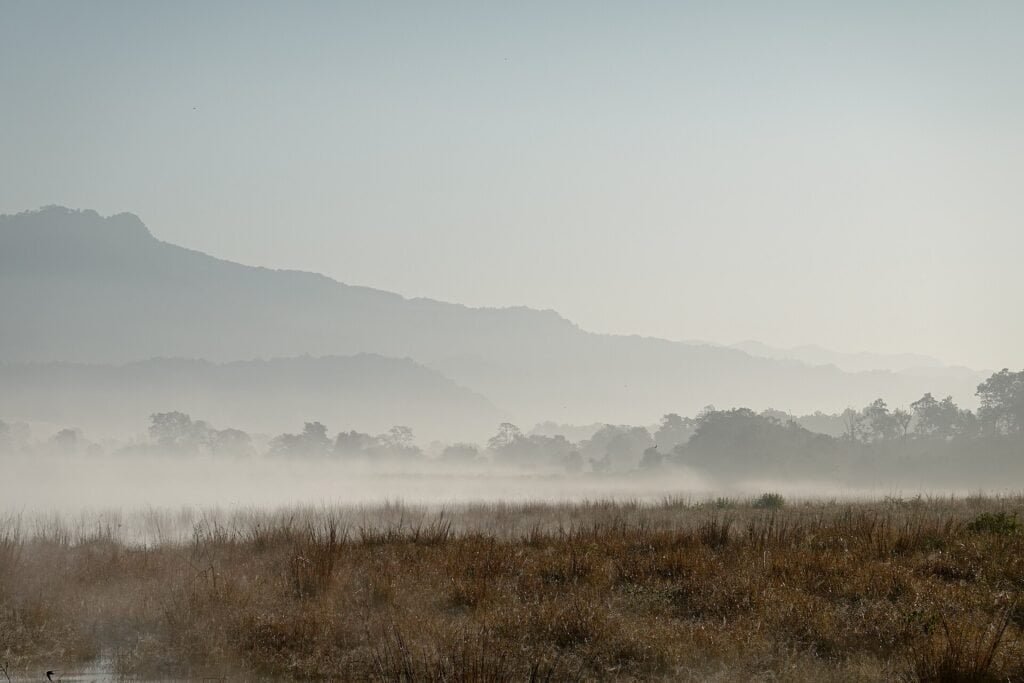
Jim Corbett National Park sits at the base of the Himalayan foothills in Uttarakhand. That gives Jim Corbett weather three distinct seasons. Winter runs cold and dry from November to February. Summer turns hot from March to June. Monsoon brings heavy rain from July through most of October. Daytime temperatures swing from around 20°C (68°F) in January to over 38°C (100°F) in May. The park closes most of its zones during the monsoon.

Jim Corbett weather by month: temperature and rainfall
Corbett’s weather follows the same broad pattern every year, though exact daily conditions vary. The table below gives typical ranges, not a live forecast. The figures come from long-term climate normals for the Ramnagar area. Sources are listed at the end.
| Month | Day high | Night low | Rainfall | Conditions |
|---|---|---|---|---|
| January | 20°C / 68°F | 6°C / 43°F | Low | Cold, foggy mornings |
| February | 23°C / 73°F | 8°C / 46°F | Low | Mild, clear skies |
| March | 28°C / 82°F | 13°C / 55°F | Low | Warming quickly |
| April | 33°C / 91°F | 17°C / 63°F | Low | Hot, dry |
| May | 38°C / 100°F | 23°C / 73°F | Low–moderate | Peak heat |
| June | 36°C / 97°F | 24°C / 75°F | Rising | Humid, pre-monsoon |
| July | 32°C / 90°F | 24°C / 75°F | High (~550mm) | Monsoon peak, most zones closed |
| August | 31°C / 88°F | 23°C / 73°F | High (~500mm) | Monsoon continues |
| September | 31°C / 88°F | 22°C / 72°F | High, tapering | Late monsoon |
| October | 29°C / 84°F | 15°C / 59°F | Low | Post-monsoon, zones reopening |
| November | 24°C / 75°F | 8°C / 46°F | Low | Cool, most zones open by mid-month |
| December | 20°C / 68°F | 5°C / 41°F | Low | Cold, foggy mornings |
Annual rainfall around Ramnagar averages roughly 1,800mm (71 inches). July and August alone account for more than half of it.
Summer (March–June): hot, but the tree cover helps
Summer days climb into the high 30s°C and occasionally touch 40°C in May and June. Corbett’s forest canopy keeps safari routes noticeably cooler than the open plains nearby. Mornings stay comfortable into April. By May, afternoon safaris get genuinely uncomfortable and most visitors book the early morning shift only. Water sources shrink as summer goes on. That pulls wildlife toward the remaining rivers and waterholes, a tradeoff covered in more depth on best time to visit.
Monsoon (July–October): heavy rain, most zones closed
The core zones, Dhikala, Bijrani, Durga Devi, Garjia and Phato, close for the monsoon from around 1 July. Bijrani and Garjia reopen on 15 October, and Dhikala and Durga Devi on 15 November. Heavy rain turns forest tracks to mud. It also raises the risk of landslides near the river corridors, so the closure is a safety measure, not just a formality. Jhirna, Dhela and Sitabani stay open year-round. They’re the only way to safari Corbett during monsoon. Check our zone-by-zone comparison for what each one offers. Humidity during this stretch runs 60–70%, well above what winter or summer visitors experience.
Winter (November–February): cold mornings, the most requested season
Winter mornings drop close to freezing in December and January. It’s cold enough that safari jeeps hand out blankets at the gate. Days warm to a comfortable 20–23°C by midday. Mist is common at dawn. It can delay the start of a morning safari, or soften early photographs, depending on how you look at it. This is the most heavily booked season on the calendar. Gate slots and where to stay options sell out furthest in advance as a result. For the full planning picture, see our planning hub.
Jim Corbett weather: frequently asked questions
Daytime temperatures average around 20°C (68°F) in winter. Summer highs reach 33–38°C (91–100°F), and monsoon days run 31–32°C (88–90°F). Winter nights can drop to 5–6°C (41–43°F).
July and August are the wettest months. Together, they account for more than half of the roughly 1,800mm (71 inches) of rain the Ramnagar area receives annually.
Yes. Daytime highs reach the high 30s°C and occasionally touch 40°C in May and June. The park’s forest cover keeps safari routes cooler than the open plains outside it, though.
Yes. Early morning temperatures can fall close to freezing in December and January. A warm jacket, gloves and a cap are worth packing, even though afternoons warm up considerably.
Yes, humidity typically runs 60–70% from July through September, noticeably higher than the drier winter and summer months.
Source: India Meteorological Department climate normals and Jim Corbett National Park (Wikipedia). Last verified 2026-08-01.